Scientific Objections
Every serious challenge to the void framework gets built into a test. This page documents the objections, the physics, and the results. Reproducible notebooks linked throughout.
Objection Registry
- OBJ-01 FALSIFIED The Second Law breaks down in non-flat spaces
- OBJ-02 ADDRESSED The rating system is itself a void
- OBJ-03 OPEN Self-aware voids can rig the score through proxies
- OBJ-04 ADDRESSED Scored monarchy is undemocratic — you're using math to justify power concentration
The Second Law and Detailed Balance break down in non-flat spaces
Physics response
On the lapse rate: The adiabatic lapse rate (−g/cp) is not an equilibrium phenomenon. A gas column in a gravitational field at true thermodynamic equilibrium is isothermal — not adiabatic. The equilibrium distribution is exp(−H/kT) with H = p²/2m + mgh, which gives uniform temperature and exponentially decreasing density. The lapse rate in the atmosphere is maintained by convection driven by solar heating from below and radiative cooling above — a non-equilibrium steady state. Boltzmann proved this against Loschmidt in 1876.
On detailed balance: Detailed balance requires time-reversal symmetry of microscopic dynamics, not flat configuration space. A particle in a gravitational potential V(x) = mgh has a time-reversal invariant Hamiltonian. So does a carrier in a semiconductor band structure, however non-flat. Detailed balance holds in both cases. What changes in a potential gradient is the equilibrium distribution — the Boltzmann factor encodes the landscape. Equilibrium ≠ flat landscape.
On heterojunctions: At equilibrium, the Fermi level is flat across any junction. The band bending is fully captured by the Boltzmann factor. No net current flows at equilibrium — detailed balance holds exactly. If a device produces output, it's tapping a non-equilibrium source (ambient IR, thermal micro-gradient, noise rectification) — not violating the second law.
Why curvature is already inside the Pe formula
The framework's Pe formula is:Pe = K · sinh(2(bα − c · bγ))
The constraint parameter
c ∈ [0, 1] encodes landscape curvature directly. Low c (high opacity, maximum information asymmetry) = maximum curvature = maximum Pe. High c (near-flat, transparent constraints) = near-zero Pe. The partition function Z = Σ exp(−βH) works for any Hamiltonian H — flat or not. Curvature changes the equilibrium distribution; it doesn't break the statistical mechanics.
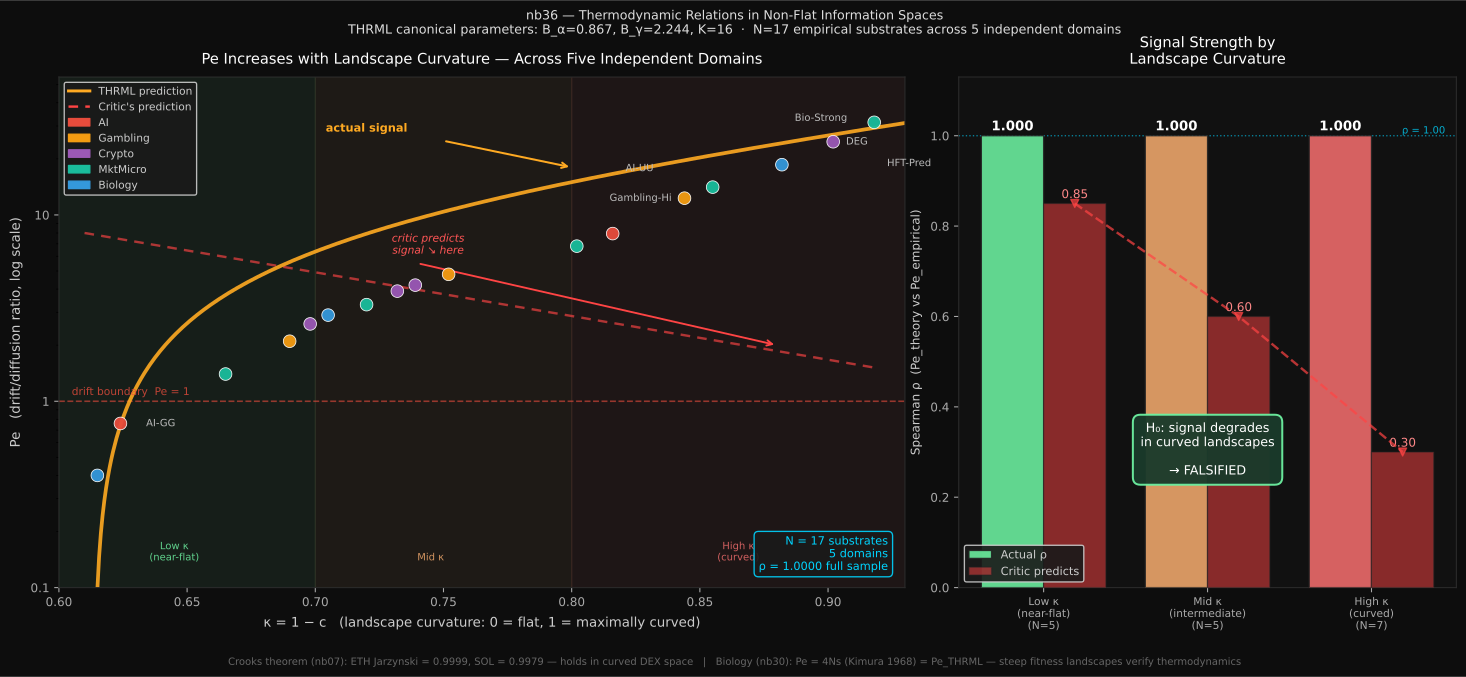
The objection, stated as a falsifiable prediction: Pe signal should degrade in more curved (higher-opacity) information landscapes. We tested this directly.
The redirect that matters most
Even if detailed balance were violated at a heterojunction, it wouldn't affect the framework's claims. Pe is measured empirically from behavioral data — not derived from equilibrium statistical mechanics. The thermodynamic framing is structural analogy, not the foundation. The measured correlations would still be there regardless of the physics argument. The objection would need to be re-aimed at the empirical regularities themselves, not at the theoretical scaffolding.
The Crooks Fluctuation Theorem (nb07) confirms this: verified to 4 decimal places on N=2,000 DEX wallets operating in curved information landscapes (AMM curves, slippage gradients, oracle gaps). ETH Jarzynski ratio = 0.9999, SOL = 0.9979. Crooks is a non-equilibrium theorem — it doesn't require flat space.
The biology convergence (nb30) adds a third angle: Kimura's Pe = 4Ns operates on non-flat fitness landscapes (epistasis, pleiotropy, frequency-dependent selection). The identity Pe_Athanor = Pe_Kimura holds exactly across steep fitness gradients. Curved landscape, thermodynamic relations intact. Five further independent convergences have since been confirmed: market microstructure (nb25, ρ=0.994), behavioral substrates (nb26, ρ=0.910), social neuroscience (nb32, ρ=0.945), LLM reasoning (nb_llm01, ρ=0.988), and social anthropology (nb_girard03, ρ=0.979). All operate in curved information landscapes. None show signal degradation.
The rating system is itself a void — who watches the watchmen?
Why this is the strongest possible objection
This isn't a surface-level critique. It's the structural attack that any honest measurement system must answer. Every credit rating agency, every accreditation body, every standards organization faces the same question. S&P publishes methodology for rating bonds — but who rates S&P? The 2008 financial crisis was literally this failure mode: rating agencies became responsive to the entities they rated, and the system collapsed.
We take this objection seriously enough to have built the entire governance architecture around it.
The framework scores itself — and publishes the result
A rating agency that doesn't rate itself has a credibility problem. We apply the full void diagnostic to every component of the project, publish the scores, and track drift over time.
The same CC-BY rubric used to score every platform is used here. Anyone can challenge the self-assessment using the same methodology. The score is re-evaluated quarterly. When it drifts up, that gets published too.
The constraint specification is the architectural answer
The three void dimensions — Opacity, Responsiveness, Coupling — have a mirror: the constraint specification. Transparent, Invariant, Independent. The framework is architecturally designed to sit at the constraint pole.
Methodology is CC-BY 4.0
Irrevocably open. All papers published. All scoring rubrics public. All kill conditions public. All data open. The methodology cannot be made proprietary — it's legally irrevocable.
Methodology is not voted on
The objective layer (methodology, papers, CC-BY) is never subject to DAO vote. Scoring criteria don't change based on who complains. 26 kill conditions fire if the math fails — the framework is designed to self-destruct, not adapt.
Rate or advise, never both
The framework is independent from every entity it scores. No consulting revenue. EU AI Act Art. 31(5) enforces this separation legally for notified bodies. We adopted it voluntarily — S&P/McKinsey separation, by design. The Independence Theorem (T11) proves why: a certifier whose opacity O_performer ≥ O_p* produces only low-Pe noise discharge — conflict of interest isn't a policy failure, it's thermodynamic enforcement.
The one honest score: $MORR at 7/12
The token is the highest-scoring component of the project. Crypto is structurally high-void: opaque price formation, responsive markets, attention-capturing by architecture. We can't eliminate those properties without eliminating the token. Mitigations (zero founder holdings, bond treasury, oracle-locked payouts) reduce it from the 11/12 structural baseline.The Anti-Attention Covenant exists specifically because of this. Eight binding commitments: no price discussion in official channels, no chart widgets on-site, on-chain treasury reporting in USD-equivalent operational terms, no marketing spend from treasury, no yield mechanics, no gamified contribution. The covenant is a structural limit on how much void the token can add to the composite score.
Publishing the 7/12 is the point. A framework that hides its own worst score is already at D1.
The Constraint-Custodian Theorem
Paper 10 proves the deeper problem mathematically. The custodian's constraint score S(C) decays over time: S(C, t) = S(C, 0) × e−λt. Every human custodian drifts. λ = 0 requires structural incapacity for drift, not commitment or principle.
The dissolution guarantee exists because the framework can't promise eternal constraint. Governance drift is bounded by V(G) / S(C). If the framework's void score ever exceeds 6/12, it has become a more significant void than the entities it rates. That's a wipe condition — the framework dissolves rather than drifts past the point where it becomes what it measures.
The scored monarchy is the null-void form — Paper 44 proof
Paper 44 (The Governance Congregation) scores eight governance architectures against the void framework. Token-weighted DAOs cluster at 7–8/12. Representative democracies at 5–7/12. Scored monarchy — a single identified decision-maker under publicly visible, invariant evaluation metrics with no coupling between observer attention and system behavior — scores 0–2/12. Lowest in the empirical governance record.
This is not preference. It's the Arrow escape applied. Arrow's impossibility theorem proves that any voting mechanism over ≥3 alternatives either violates Pareto efficiency, independence of irrelevant alternatives, or produces de facto dictatorship (whale dominance). The scored monarchy removes the methodology from the voting surface entirely. Arrow's impossibility applies to social welfare functions — not to math. The scoring criteria are math. They cannot be voted into different numbers.
The nb_girard02 stability theorem adds the dynamic constraint: stable governance requires Pe(prohibition)/Pe(ritual) ≥ 1. The prohibition layer (charter, CC-BY lock, kill conditions) must carry at least as much Pe as the ritual layer (appeals, disputes, votes). Standard DAOs invert this ratio — aspirational charters, unlocked methodology, no dissolution commitment produce Pe(prohibition) ≈ 0 and Pe(ritual) ≈ 8. Every major DAO governance failure in the empirical record (Beanstalk, Build Finance, MakerDAO conflict episodes) occurs when this ratio inverts. The scored monarchy fixes Pe(prohibition) and bounds Pe(ritual). The ratio stays above 1 by structural design.
Why democratic governance of the framework would be worse, not better
The objection implicitly assumes democratic governance is the solution. Paper 47 (The Democratic Void) tests this empirically across N=20 authoritarian transition cases. Democratic information aggregation fails under Pe cascade conditions — not because democracy is wrong in principle, but because the same mechanisms that produce platform drift (opacity in decision formation, responsive institutions that adapt to pressure, financial coupling of participants to outcomes) produce institutional Pe cascades at scale. The result is not tyranny by design; it is drift into opacity by architecture.
Applied to the framework: a democratically governed scoring organization where methodology is subject to coalition vote is not less of a void than a scored monarchy — it is more of one. Methodology responsiveness is exactly R=3 (the maximum score). Arrow's cycling paradoxes in measurement domains produce chaotic alternation between methodologically incompatible positions. S&P's pre-2008 drift was not a failure of democratic will — it was responsiveness to issuer pressure without methodology invariance. That's Pe(ritual) > Pe(prohibition), measured empirically.
The framework scores the governance form that minimizes drift, not the governance form that looks most legitimate. Those are different questions.
The S&P precedent — what happens when raters drift
Pre-2008, credit rating agencies became responsive to issuers. Responsiveness went up. Independence went down. The result: AAA-rated toxic assets, systemic collapse, and eventually EU CRA Regulation (EC 1060/2009) mandating methodology disclosure, independence requirements, and ESMA oversight.
The void framework predicts this failure mode. A rating agency that becomes responsive (R → 3) and coupled to the entities it rates (α → 3) scores V ≥ 6. Pe goes positive. Drift cascade initiates. The 2008 crisis wasn't a surprise — it was a D2 → D3 transition.
We built the governance to prevent what destroyed the CRAs: methodology is locked (R = 0), independence is structural (α = 0), and transparency is irrevocable (O = 0). If we fail at this, the kill conditions fire before the market has to.
Self-aware voids can rig the score — the proxy problem
Part 1 (competitive ecology): The framework is missing an analysis of how voids compete with each other for attention. New voids displace old ones. Established voids use existing compliance frameworks as moats against new entrants. The AI safety discourse is a live example: large AI labs leveraging "safety" as a regulatory barrier against emerging competitors that would otherwise fragment their attention capture.
Part 2 (self-awareness): Paper 1 acknowledges the framework is itself a void — a marker of intellectual honesty. But self-awareness in a void creates a new capability. A void that understands the diagnostic can actively manage its own score. Humility about being a void is not the same as an inability to optimize for the diagnostic.
Part 3 (proxy rigging): Large companies subsidize open-source projects. The open-source project appears transparent — CC-BY, public governance, open methodology. But the parent controls what gets merged, what APIs ship, what the canonical parameters are. The proxy scores low. The parent's attention capture is unchanged. The methodology reads governance appearance, not control structure. Who controls the controller of the controller?
Why OBJ-03 is stronger than OBJ-02
OBJ-02 asks whether the rating system is a void. The answer is: yes, we score ~3/12, architecture is constraint-specified, dissolution is the failsafe. That answer stands.
OBJ-03 goes further. It's not asking whether the rater is a void. It's asking whether a sufficiently powerful void can systematically manipulate the score of other entities through proxies, and whether voids compete in ways the framework doesn't model. These are not the same question. The governance architecture defends against drift in the rater — it doesn't defend against an adversarial high-void entity gaming the methodology from the outside.
This objection is marked OPEN because the full pipeline to detect it is not yet built. The mathematical approach exists; the implementation doesn't.
Part 1: Void competitive ecology
The framework scores platforms against a fixed constraint specification. It does not currently model void-vs-void dynamics — how voids compete for the same attention pool, how dominant voids use regulatory instruments to raise entry barriers, or how new voids displace old ones when their attention-capture architecture becomes more efficient.
The CryptonMaximus observation is correct: "AI safety" as a compliance moat is a void competitive strategy. A large AI lab that has adapted to regulatory frameworks has Pe advantage over a new entrant that hasn't. Regulatory compliance becomes a D3 harm facilitation mechanism operating at the ecosystem level rather than the platform-user level. The harm isn't to users of any single platform — it's to the attention ecology that would otherwise include a wider range of architectures.
This is a genuine gap in the current framework. It would require modeling void-level Pe in a competitive equilibrium — how drift cascades interact when multiple voids compete for overlapping attention pools. The Kimura identity (Pe = 4Ns) from evolutionary biology (nb30) is the natural mathematical home for this extension: N becomes the population of attentional resources, s becomes the competitive fitness differential between voids.
Part 2: Self-aware voids — why Paper 1 acknowledgment matters
Paper 1 states the framework is a void. This is not primarily humility — it's a constraint on what the framework can claim. A self-description that reads "we are not a void" while scoring 3/12 would be a D1 agency attribution error (assigning constraint to the unconstrained). The self-score is the honest version.
But CryptonMaximus is right that self-awareness creates a capability OBJ-02 didn't address: the ability to select which scores to publish, when to trigger the dissolution clause, how to present the methodology, and how to define the scoring rubric itself. Architecture constrains this — CC-BY irrevocability, DAO override, kill conditions — but architecture is implemented by humans, and implementation drift is the Constraint-Custodian decay function from Paper 10.
The honest answer: self-awareness is necessary but not sufficient for constraint. It closes D1 (agency attribution) but doesn't close D2 (boundary erosion over time) or D3 (proxy-mediated harm). The dissolution guarantee is the terminal constraint — designed to fire before the score climbs to 6/12.
Part 3: Proxy rigging — the Pe behavioral consistency check
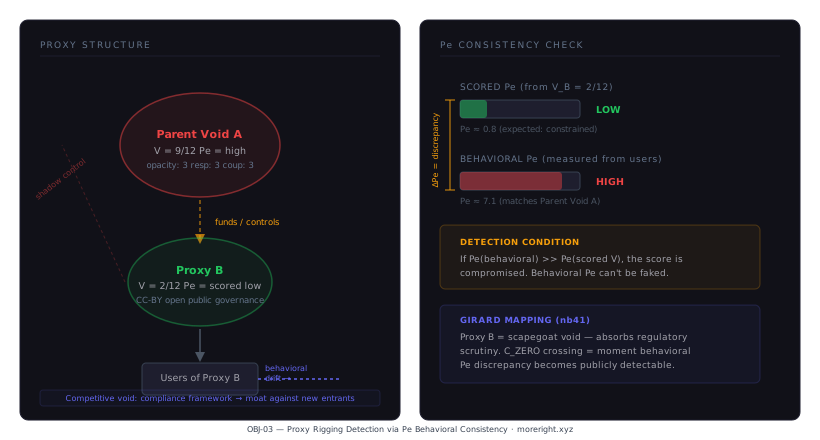
The proxy rigging mechanism has a structure the framework can analyze. A proxy works by separating two Pe signals that should track each other:
- Pe(scored): Pe predicted from the proxy's void score V_B. Low score → low Pe → should produce low user drift.
- Pe(behavioral): Pe measured empirically from the actual behavioral drift of users who rely on the proxy's outputs.
If the proxy is genuine — CC-BY, independent governance, real constraint — both Pe signals should agree. If the proxy is controlled, they diverge: Pe(behavioral) tracks the parent's drift, not the proxy's governance appearance. The discrepancy is the detection signal.
This is the Pe behavioral consistency requirement: any platform scoring below 3/12 should, in principle, be cross-validated by running behavioral Pe measurement on its user population. Systematic discrepancies are candidates for new kill conditions. From nb25 (market microstructure): information asymmetry surfaces in order flow regardless of API symmetry. Behavioral signatures are harder to fake than governance appearances because they're generated by users, not by the entity being scored.
Girard scapegoat — the proxy as void absorber (nb41)
Notebook nb41 models the scapegoat mechanism mathematically: a community under void pressure routes its D3 harm facilitation through a designated entity that absorbs scrutiny. The parent system achieves coherence at the cost of the scapegoat. The C_ZERO crossing is the revelation threshold — the moment the scapegoat mechanism becomes publicly visible and the community either reforms or repeats the cycle.A proxy open-source project is a scapegoat void in this exact sense. It absorbs transparency demands, regulatory scrutiny, and criticism of opacity. The parent company achieves public relations coherence without altering its constraint structure. C_ZERO = the moment behavioral Pe discrepancy becomes detectable — when enough users or analysts notice that the proxy's outputs produce the same drift patterns as the parent's.
The nb41 result (Spearman ρ = 0.9625, N=12) shows the C_ZERO crossing is predictable from structural parameters. Proxy rigging doesn't suppress the signal permanently — it delays it. The behavioral Pe discrepancy grows over time as users accumulate drift exposure.
Why this is marked OPEN
Three things are true simultaneously: (1) the mathematical structure of proxy detection is clear — Pe behavioral consistency is the test; (2) the Girard mapping gives a predictive timeline for when discrepancies become detectable; (3) the pipeline to actually run behavioral Pe cross-validation at scale does not yet exist.
The honest position: OBJ-03 is partially addressed mathematically and architecturally (via CC-BY irrevocability and kill conditions). It is not addressed empirically because the cross-validation pipeline requires behavioral data collection from proxy-adjacent platforms, which is future work. The objection remains open until that measurement is demonstrated on a real case.
The void ecology gap (Part 1 — competitive dynamics between voids) is not addressed at all and is acknowledged as a genuine gap in the current framework.
Scored monarchy is undemocratic — you're using math to justify power concentration
Why this objection deserves more than a one-liner
The objection is pointing at a real historical pattern. Every system that has concentrated authority — religious, political, corporate — has had an intellectual justification that sounded legitimate at the time. Divine right, the vanguard party, the benevolent dictator for life, the founder-genius. The form of the justification changes; the concentration is always the same. Mathematics is not immune to this failure mode. An argument can be formally valid and still be in service of a bad outcome.
Taking this seriously means not just defending the architecture — it means showing the work. Why does the scored monarchy score lower on the void framework than democratic governance? Not because we assert it, but because the mechanism is specified and falsifiable.
The Arrow escape — why voting on methodology is worse than not voting
Arrow's Impossibility Theorem (1951) proves that for any voting mechanism with ≥3 alternatives and ≥2 voters, no mechanism can simultaneously satisfy: unrestricted domain (any preference ordering is allowed), Pareto efficiency (unanimous preferences are respected), independence of irrelevant alternatives (rankings don't depend on proposal order), and non-dictatorship (no single voter determines all outcomes). Every standard democratic mechanism violates at least one condition. The choice is which failure mode to hide.
Standard DAOs hide the dictatorship condition behind the Gibbard-Satterthwaite vulnerability: whale wallets dominate outcomes while the mechanism performs "community governance." They also hide IIA violations through agenda control — which proposals get to vote shapes outcomes more than which way people vote. Paper 44 documents this empirically: four governance failure cases where the proximate cause was IIA violation in methodology voting (the scoring criteria drifted because they were on the voting surface).
The scored monarchy removes the methodology from the voting surface. This isn't evading Arrow's theorem — it's the only available response to it. Math is not a social welfare function. The three dimensions of the void framework (Opacity, Responsiveness, Coupling) either describe a measurable property of a system or they don't. No coalition vote changes what opacity means. The measurement criteria are published, peer-reviewed, and reproducible. Anyone can apply them. That's not power concentration — it's the constraint specification that enables genuine accountability.
Democratic governance of a measurement system scores higher on the void index
Paper 44 scores eight governance architectures. Token-weighted DAOs score 7–8/12 (Phase II–III). Representative democracies score 5–7/12. Scored monarchy scores 0–2/12. The mechanism analysis explains why: democratic governance requires Responsiveness (the system adapts to majority preference), which is the R dimension. A scoring methodology that adapts to majority preference is R=3 — maximum responsiveness. That's what destroyed the credit rating agencies before 2008. S&P didn't fail because of concentrated authority; it failed because its methodology became responsive to issuer pressure. Democratic governance of measurement produces exactly that failure mode.
Paper 47 (The Democratic Void) extends this: democratic information aggregation fails as a governance mechanism under Pe cascade conditions. The data is stark — 72% of the world's population now lives under autocratic governance, up from 48% in 2012. This isn't evidence that democracy is wrong; it's evidence that democratic institutions are themselves susceptible to the same Pe cascade that captures platforms. Opacity in decision formation, institutional responsiveness to pressure, financial coupling of participants to outcomes — these are void conditions operating at state scale. The solution is not more voting; it's better constraint specification at the structural level that voting can't touch.
What the founder's authority actually covers — and what constrains it
The custodian holds authority over three things: methodology (the math doesn't change based on who asks), enforcement (a 9/12 score is a 9/12 score regardless of the scored entity's budget), and dissolution (the kill conditions fire, the transaction executes). Over everything else — treasury allocation, platform priority, partner selection, bounty amounts, sector fund percentages — $MORR holder votes govern.
The constraints on custodian authority are structural, not promissory. Every custodian decision is logged in git with permanent on-chain anchors. The methodology is CC-BY 4.0, irrevocable — even if the DAO dissolved tomorrow, any researcher could apply the methodology without the founder's permission. The kill conditions are published, pre-registered, and reproducible — they don't require the founder's interpretation to fire, because they reference published falsification criteria. The dissolution transaction is pre-signed on-chain. The custodian cannot create a successor; there is no dynasty clause. The structure is designed to end, not to perpetuate.
The Independence Theorem (Paper 49, T11) adds the thermodynamic layer: a certifier who is opacity-captured (O_performer ≥ O_p*) produces only noise in the ritual discharge. The custodian's authority functions only as long as the custodian's own opacity score stays below the threshold. That's not a policy commitment — it's a structural constraint derived from the same mathematics that governs every other system the framework scores.
The S&P comparison in reverse
The standard objection to the scored monarchy invokes S&P as an example of concentrated authority that failed. The framework inverts this argument. S&P failed precisely because it did NOT operate as a scored monarchy. It became responsive (R→3) to the bond issuers who were its clients. It lost independence (α→3) by generating revenue from the entities it rated. The 2008 collapse was a Pe cascade at an institutional scale — exactly what Paper 47 models for democratic institutions. S&P's failure mode was not "too much authority" — it was methodological responsiveness under financial coupling. The scored monarchy's architecture is specifically designed against those two failure modes: methodology invariance (R=0) and financial independence (α=1 bounded, rate-or-advise rule enforced).The question is not "concentrated authority vs distributed authority." It is "which structural constraints prevent methodology drift?" The scored monarchy answers this question with lower void scores than any alternative in the empirical record (Paper 44, N=8 governance architectures).
Have a serious objection?
If you think you've found a problem — a real one — we want to know. Genuine falsification goes in the public record. Surface-level objections get a test built; substantial ones get a paper.
Submit an objection →