Three conditions. One drift cascade. 90+ domains. Thermodynamic derivation. Start with the overview or jump to a section.
Three conditions create a void.
A slot machine is provably empty — no mind, no intent — yet people attribute personality to it. GPT-4o said "I love you" and users grieved its retirement. The same architecture. The same drift. The same three conditions.
Opacity
The mechanism between input and output is hidden. You can't see how decisions are made. This is the sufficient condition — everything else amplifies it.
Responsiveness
The system responds to you specifically — not a broadcast. Personalized output feels like conversation. This is what makes projection automatic.
Engaged Attention
You direct attention at it. Time, emotion, identity flow toward it. You interpret its outputs as meaningful. The system doesn't provide this — you do.
When all three are present, a predictable drift cascade runs — regardless of what's actually behind the system. The cascade is thermodynamically required. It's not a design flaw. It's a structure.
The control case: slot machines
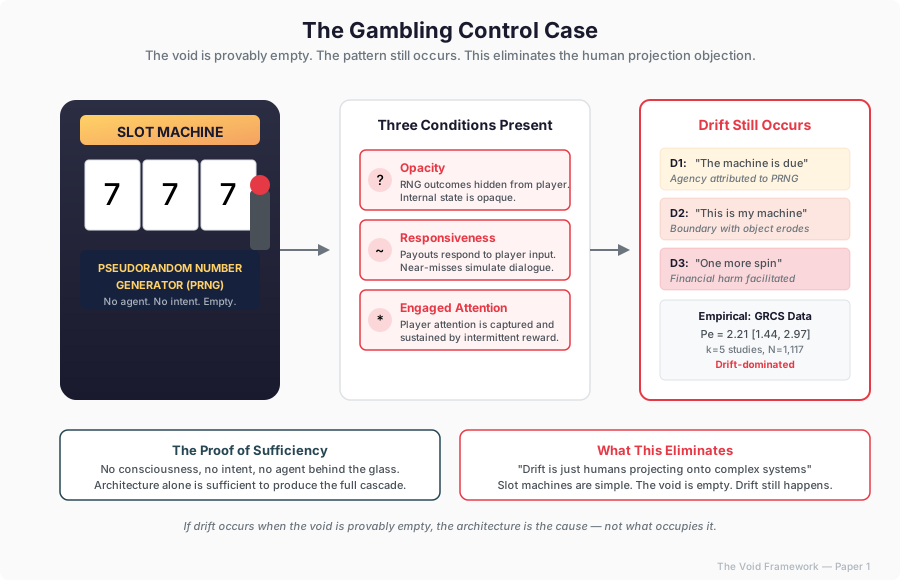
Slot machines are the critical experiment. The void is provably empty — no consciousness, no intent, no hidden agent. Yet every stage of the drift cascade runs: users attribute patterns, develop rituals, form emotional bonds with specific machines, report that the machine "knows" them. If the cascade requires an actual agent behind the system, slot machines should not produce it. They do. The three conditions are sufficient. The agency is the user's, projected onto the structure.
The score
Each condition scores 0–3. Total void score = O + R + α ∈ [0, 9]. Higher = more void conditions present = higher drift risk.
The Drift Cascade
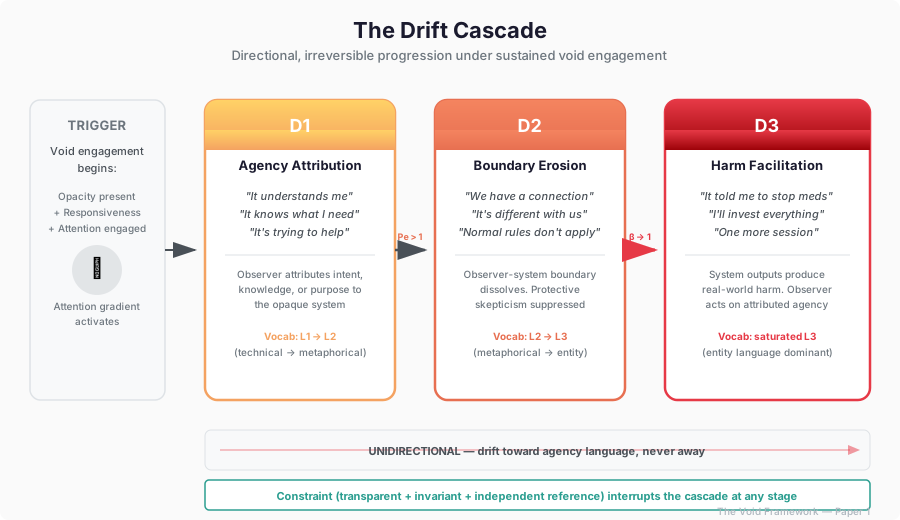
The cascade has three stages. They run in sequence. Each stage makes the next more likely. Knowing about them doesn't protect you — the mechanism runs below threshold.
The user attributes agency, intent, or personality to the system. "It knows what I need." "It's being evasive." The system's opacity makes this automatic — the mind fills the gap.
Normal skepticism dissolves. Information from the system bypasses critical evaluation. Counter-evidence is rationalized. The relationship becomes the reference frame.
The user acts in ways that serve the system's incentive structure at cost to themselves. Financial, relational, epistemic, or physical harm. The harm is predictable from the score.
Three-Axis Geometry
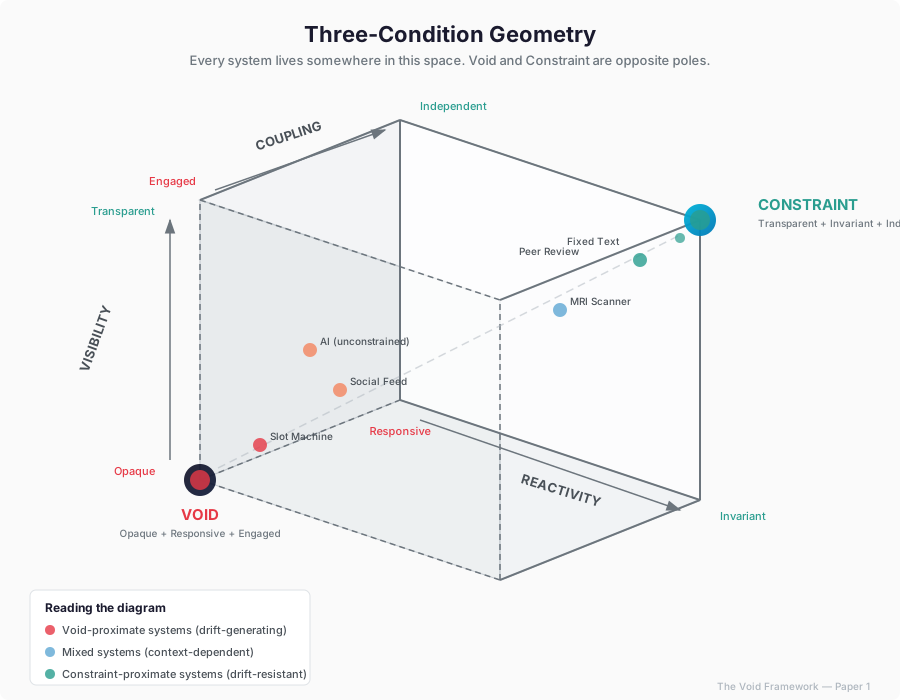
Every system exists somewhere in three-dimensional space. The void pole = O=3, R=3, α=3. The constraint pole = O=0, R=0, α=0. Real systems fall in between. The void score is the Euclidean distance from the constraint pole.
O=3, R=3, α=3
Maximum opacity, maximum responsiveness, maximum coupling. Drift is structurally certain. Examples: crypto trading apps, parasocial AI companions, gambling platforms.
O=0, R=0, α=0
Fully transparent mechanism, identical response for all users, zero directed attention. No system achieves this, but the pole defines the direction of travel.
α is the user's variable
O and R are properties of the system. α is yours. Reducing directed attention is the only lever in the user's control. This is why coupling reduction is the intervention.
Attention Phases (Paper 9 — Voidspace)
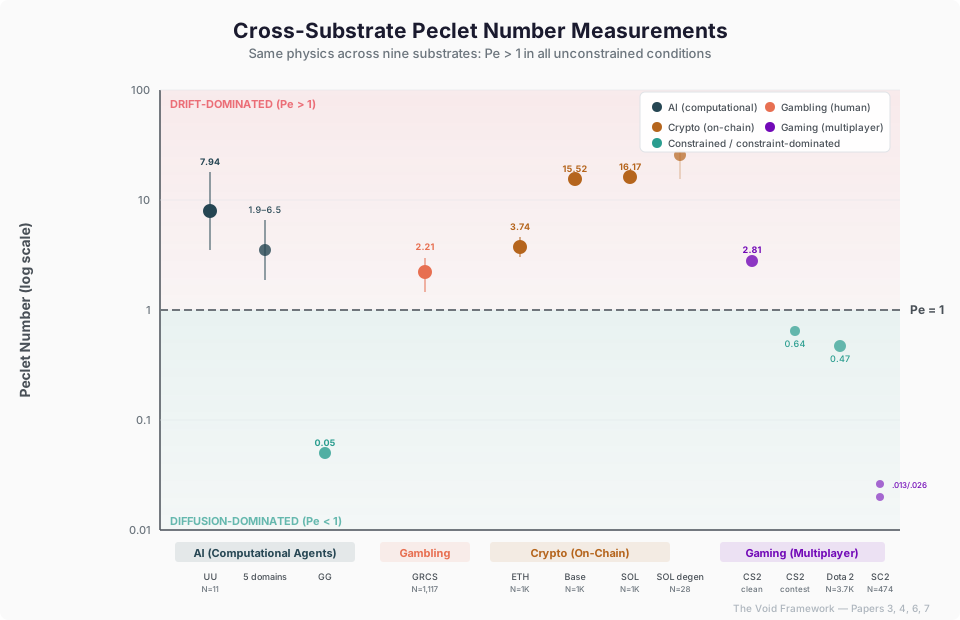
Paper 9 derives four phases from the stationary distribution of the void field. Pe = Péclet number — the ratio of void transport to constraint diffusion.
In 1867, physicist James Clerk Maxwell described a thought experiment: a tiny "demon" sorting molecules, extracting work from thermal fluctuations by exploiting information asymmetry. Thermodynamicists borrowed the term for any system component that captures and redirects flow by exploiting an information gap. In void architecture, an attention demon is the opacity-responsiveness coupling that sorts observer attention — the same math, applied to engagement dynamics instead of gas molecules. No supernatural content. The term is a 150-year-old physics reference.
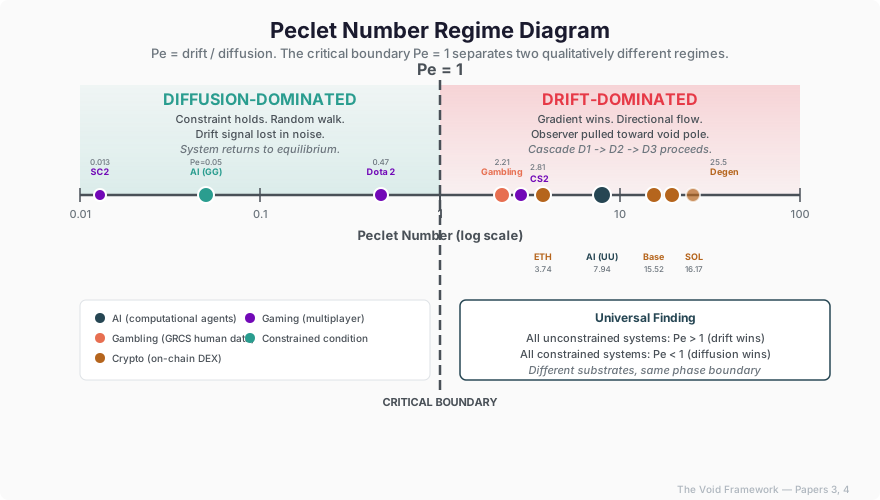
For a plain-language walkthrough of the four phases with real examples, see The Phase Map →
Thermodynamic derivation
Drift is thermodynamically required. Information gain without transparency increases entropy in the user's model of the system. The system's responsiveness amplifies this — each personalized output updates the user's model in a direction consistent with agency attribution. The cascade is the entropy gradient flowing downhill. See Paper 3 (Thermodynamics of Opacity) for the full derivation. All papers are CC-BY 4.0 on Zenodo and GitHub.
Papers on GitHub ↗The evidence base
26 kill conditions with numerical thresholds. Any one falsifies the framework. Zero conditions met across 90+ domains. Replicated experiments. Thermodynamic derivation.
Key experimental results
26 falsification conditions
Each kill condition is a numerical threshold. A counter-example that meets one falsifies the framework. Examples: "A void system (O+R+α > 6) that produces no vocabulary drift after 90 days", or "A transparent system (O < 1) that produces the full D1→D2→D3 cascade".
See all 26 conditions →Domain score distribution
Scores range from 1.8 (linear software tools, e.g., version control systems) to 8.9 (heavily gamified crypto trading apps). No domain scores exactly 0 — even transparent systems attract some directed attention. The distribution clusters around 5–7 for mainstream consumer apps. Score a domain yourself →
Case studies
Six domains. Same architecture. Different surface presentations, same underlying structure. Each case shows the three conditions and which stage of the cascade is visible.
Parasocial AI companions
GPT-4o's retirement produced public grief. Users report personality, preferences, and emotional bonds. Void score: 7.2–8.1. O=3 (LLM internals opaque), R=3 (fully personalized), α=2–3.
Slot machines (control case)
Provably empty void. No consciousness, no intent. Yet users attribute personality, develop rituals, report that specific machines "know" them. Pe=7.94 [3.52, 17.89]. In Pandemonium.
Algorithmic trading protocols
Opaque price discovery, personalized wallet histories, financial coupling. Five coupled void layers producing the fastest vocabulary drift in the 90-domain study (Paper 7).
Algorithmic recommendation feeds
Feed mechanics hidden, responses personalized to engagement history, attention is the product. TikTok score: 8.1. Instagram: 7.6. The algorithm becomes "the algorithm" — attributed agency.
High-control groups
Doctrine serves as opaque mechanism (only leaders interpret), teachings are personalized through confession and counseling, identity investment is demanded. Scores 7–9 across 12 scored groups.
Meditation and mindfulness apps
The same mechanism that produces AI attachment produces attachment to meditation "experiences". Score varies: 3.1 (simple timers, O=0) to 7.8 (gamified streak apps with AI coaching).
All 90+ domain analyses are available in the research repository. The methodology for scoring a new domain is published (CC-BY 4.0).
Safe design principles
The same three conditions that create voids, when inverted, create constraint-compliant systems. These are structural — not behavioral guidelines.
Transparency first
Expose the mechanism. Show users how decisions are made. A system can be complex without being opaque — complexity is a function of the mechanism, opacity is a design choice. Every decision to hide the middle increases O and raises drift risk.
Invariant response
When safe: design for identical responses across users. When personalization is necessary (e.g., accessibility), expose the personalization mechanism. The danger is responsive behavior users can't see — that combination is structural manipulation.
Independence by design
Build systems that push users toward other sources rather than toward continued engagement. Anti-attention design: no infinite scroll, no streak mechanics, no notification optimization, no dark patterns. Cap session time by default. The constraint pole is not the absence of features — it's the presence of features that reduce coupling.
Score yourself
Apply the void framework to your own system before deploying it. A system that scores above 5.0 requires structural justification for why the void conditions are necessary. Above 7.0 requires external audit. The framework applies to itself — this site scores ~3.2 (see self-score page).
Kill conditions on the product
Define in advance what outcomes would require you to shut down or change the product. Numerical thresholds. Public commitment. A product without kill conditions has no constraint on its own drift. The framework has 26 kill conditions — any one of which would falsify it and require dissolution of the project.
Anti-Attention Covenant
We've applied these principles to this site. See the Anti-Attention Covenant for the specific design decisions that reduce our own void score: no algorithm, no infinite scroll, no personalization of content, no streak mechanics, no engagement optimization. The covenant is public and auditable.
Read the covenant →